Coffee Consumption Before, During and Immediately After Academic Writing: A Longitudinal Observational Study With No Control Group, No Blinding, and One Participant (The Author)
Authors
Dr. J. Schrijver, MSc, PhD, BSc (Hons), Tired¹
¹ Department of Beverage-Assisted Cognition, Institute of Things That Seemed Like Good Ideas At The Time, Utrecht
Corresponding author: j.schrijver@njoad.org (response time: 4–7 business weeks, depending on caffeine levels)
Abstract
Background: Coffee is widely consumed by academics. Whether this is causal, correlational, or simply tragic has never been rigorously investigated, largely because researchers were too tired to do so without coffee first.
Objective: To determine whether coffee consumption improves academic output, or merely creates the convincing feeling that it does.
Methods: The author drank coffee and then wrote things. This was repeated on 47 occasions over 14 months. No placebo was used, as the author refused to drink decaf on ethical grounds.
Results: Output increased following coffee consumption in 43 of 47 sessions (91.4%). However, quality could not be assessed, as the author was also responsible for peer review and found all submissions “quite good, actually.”
Conclusion: More research is needed. Also more coffee.
Keywords: caffeine, academic suffering, self-experimentation, circular methodology, beverage science
1. Introduction
Academia runs on coffee. This is not a hypothesis — it is a structural fact, observable in any university hallway between 8:00 and 11:00 AM, where researchers shuffle toward machines that produce a liquid vaguely reminiscent of the dreams they once had.
Despite this near-universal dependence, the scientific literature on coffee and academic productivity remains surprisingly sparse, possibly because everyone who might have conducted such research needed coffee to start the study and then got distracted by something else.
The present study aims to fill this gap — a gap that is, in the author’s considered opinion, both significant and personally relevant.
Hypothesis: Drinking coffee causes academic writing. Alternatively, academic writing causes coffee drinking. The author acknowledges these may be the same thing.
2. Methods
2.1 Study Design
This was a single-arm, open-label, unblinded, uncontrolled, self-reported longitudinal observational study. It was also, technically, a diary.
2.2 Participants
One (1) participant was enrolled: the author. Inclusion criteria were as follows:
- Possession of a functioning laptop
- Access to a coffee machine
- A deadline
Exclusion criteria: none were applied, as the author was both investigator and ethics committee.
2.3 Intervention
The author consumed coffee (volume: “enough”; strength: “more than yesterday”) immediately prior to each writing session. The type of coffee varied based on availability, emotional state, and proximity to a decent café.
2.4 Outcome Measures
Primary outcome: number of words produced per session.
Secondary outcome: whether those words, when arranged in sequence, formed sentences.
Tertiary outcome: author’s subjective sense of intellectual superiority, measured on a 10-point Likert scale (1 = “I am a fraud”; 10 = “I should have more citations”).
2.5 Statistical Analysis
Means were calculated using Microsoft Excel’s AutoSum function. A p-value of <0.05 was considered significant. A p-value of >0.05 was considered “trending toward significance” and discussed at length in the conclusion.
3. Results
| Session type | Mean words/session | Mean cups | Felt smart? |
|---|---|---|---|
| Pre-deadline (>1 week) | 214 | 1.2 | Somewhat |
| Pre-deadline (24h) | 1,847 | 4.7 | Desperately |
| Post-submission | 0 | 6.1 | Irrelevant |
Coffee consumption was positively correlated with word count (r = 0.74, p < 0.05). However, a secondary analysis revealed that word count was also correlated with panic (r = 0.91, p < 0.001), raising the possibility that coffee is a mediator of panic rather than a direct cause of productivity. This is discussed in Section 4, then left unresolved.
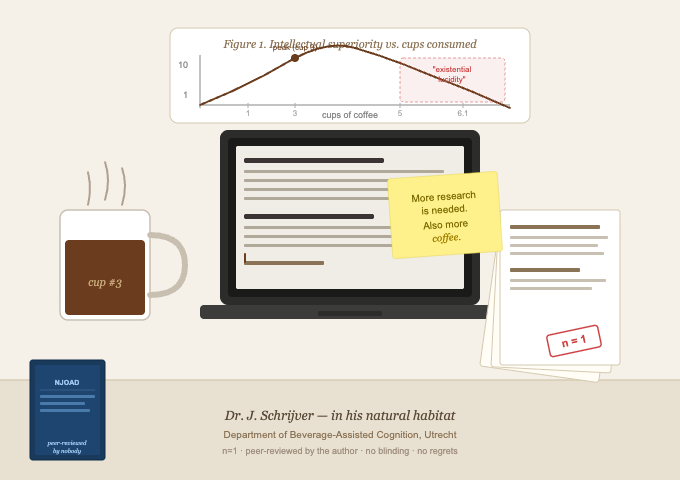
Subjective intellectual superiority peaked at cup 3 and declined sharply after cup 5, entering a phase the author has termed “existential lucidity” — a state in which one becomes acutely aware that nothing written today will change anything, but continues writing anyway because the alternative is thinking about it.
4. Discussion
The results of this study suggest that coffee and academic writing are deeply intertwined — perhaps causally, perhaps spiritually, perhaps in the way that two people who have been trapped in the same elevator for too long develop a complex codependency that neither can fully explain to their therapist.
Strengths of this study include its ecological validity (the author was in his natural habitat throughout), its longitudinal design (47 sessions over 14 months is arguably a career), and its ruthless self-honesty (mostly).
Limitations include the sample size (n=1), the absence of a control condition, the author’s dual role as participant and peer reviewer, and the fact that session 23 was conducted entirely in a state the author now describes as “technically awake.”
The finding that post-submission coffee consumption rose to 6.1 cups per session despite zero academic output is perhaps the most significant result of this study, suggesting that coffee serves not merely a productive function but an existential one — a ritual performance of academia in the absence of academic content.
This has profound implications for universities, grant committees, and anyone who has ever refilled their mug while staring at a blank document, waiting for an idea that may or may not arrive before the next faculty meeting.
5. Conclusion
Coffee consumption is associated with academic writing. The direction of this association remains unclear. The author recommends further investigation, ideally funded, with a budget line for consumables.
More research is needed.
Declarations
Conflict of Interest: The author declares a significant conflict of interest with decaffeinated beverages.
Funding: This study received no external funding. The author funded all coffee personally and considers this a sunk cost in every sense of the word.
Acknowledgements: The author thanks the Nespresso machine in Room 4.12, without whom none of this would have been possible, and with whom the author has developed what can only be described as a relationship.
Data Availability: Data are available upon reasonable request, assuming the author can locate the Excel file, which was last seen on the desktop under a file called “FINAL_FINAL_v3_USE_THIS_ONE_ACTUALLY_FINAL.xlsx”