Degenerative Rotator Cuff Repair
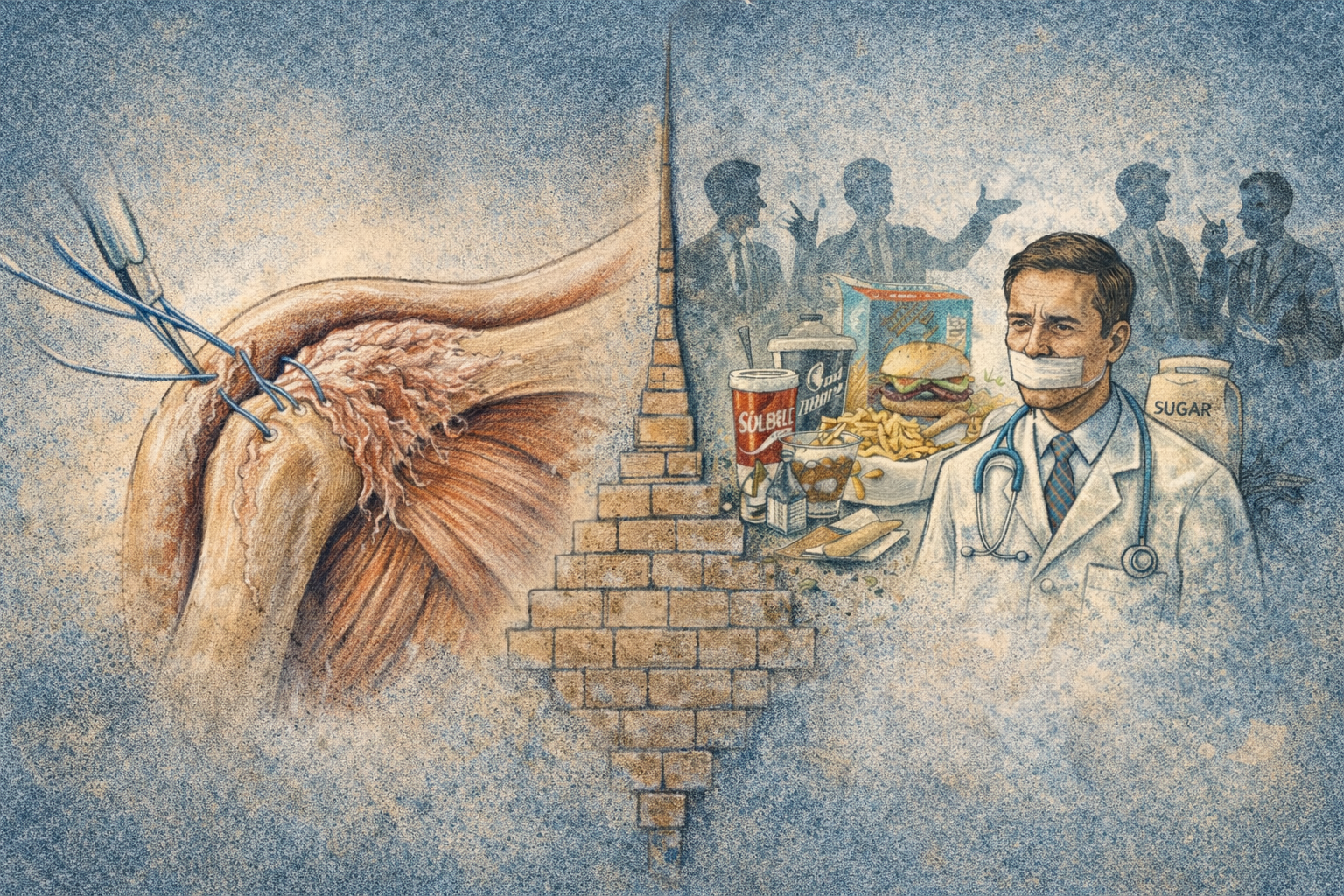
A Metabolically Optimistic Procedure
Degenerative rotator cuff tears are increasingly treated with surgical repair. The logic appears straightforward: a torn tendon causes pain, therefore suturing it back to bone should restore function. This reasoning is elegant in its simplicity and largely indifferent to biology.
Rotator cuff degeneration is not an acute event. It is a slow, progressive process that unfolds over years. The tendon becomes stiff, thickened, inflamed, poorly vascularized, and structurally compromised. In many patients, particularly those with diabetes or metabolic syndrome, the tissue is already metabolically sick long before it finally fails.
Diabetes is associated with a significantly higher incidence of tendinopathy, impaired collagen turnover, advanced glycation end-products, and reduced healing capacity. This is well described. Less often acknowledged is that roughly one third of the adult population meets criteria for metabolic syndrome. One does not need exceptional insight to suspect that the pathophysiology driving tendon degeneration in diabetics is not categorically different from that in the broader metabolically unhealthy population. It is likely the same process, only further advanced.
The degenerative tendon is not simply torn. It is biologically altered. It is caramelised tissue: stiff, inflamed, poorly adaptive, and metabolically exhausted. In this context, placing sutures through such tissue and expecting durable healing may not be the first solution one would intuitively propose.
Yet this is exactly what we do.
Rotator cuff repair persists reminds us that orthopedic surgery often treats structure while quietly ignoring substrate. Mechanical failure is addressed, while metabolic failure remains politely unmentioned. Discussion of causation becomes uncomfortable when it extends beyond anatomy and into lifestyle, nutrition, and systemic disease.
This discomfort is not accidental.
The food and beverage industry exerts substantial influence on public discourse and policy. Nutritional guidelines have historically emphasized patterns that align conveniently with industrial food production. Large institutions and belief-driven organizations, such as the 7-day Adventist Church, promote a vegan diet (the one they believe was served in the Garden of Eden). They own medical universities, have founded Lifestyle Medicine, acquired the Bluezone concept in 2020, and own cereal industries. They have played disproportionate roles in shaping these guidelines, often while maintaining commercial interests in processed carbohydrate-based products. The result is a dietary orthodoxy that discourages scrutiny of metabolic damage while promoting interventions that treat its consequences.
In this environment, talking openly about the metabolic roots of tendon degeneration is inconvenient. It threatens established narratives, funding streams, and the comforting illusion that degeneration is inevitable and age-related rather than induced.
So we repair.
We repair tendons that have been sick for years.
We repair tissue that cannot biologically respond.
We repair symptoms of a problem we are not allowed to name.
And when healing fails, we describe it as “poor tissue quality,” as if this were an unfortunate coincidence rather than the central issue.
There is, at present, little incentive to address the cause of degeneration. The system is structured to reward intervention, not prevention; procedures, not metabolic correction. In that sense, degenerative rotator cuff repair makes perfect sense, not biologically, but institutionally.
Whether it makes sense for the patient is a different question entirely.
Geef een reactie